The lower end of a capillary of radius r = 0.2 mm and length λ = 8 cm is immersed in water whose temperature is constant and equal to T low = 0ºC. The temperature of the upper end of the capillary is T up = 100ºC. Determine the height h to which the water in the capillary rises, assuming that the thermal conductivity of the capillary is much higher than the thermal conductivity of water in it. The heat exchange with the ambient should be neglected.
Use the following temperature dependence of the surface tension of water:
T, ºC 0 20 50 90
σ , mN/m 76 73 67 60
Text Solution
Verified by ExpertsCHECK THE SOLUTION.
(6.4 cm)
Sol. If h is the height of water column in the capillary, the temperature of the capillary, and hence of
water at this height, is
T h = 
Water is kept in the capillary by surface tension. If σ h is the surface tension at the temperature T h , we can
write
h =  ,
,
where ρ w is the density of water. Hence we obtain
σ h =  =
= 
 .
.
Using the hint in the conditions of the problem, we plot the graph of the function σ (T). The temperature
T h on the level of the maximum ascent of water is determined by the point of intersection of the curves
describing the ( ρ grl/2) T/T up and σ (T) dependences.
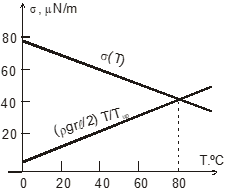
Figure shows that T h 80ºC. Consequently,
h =  6.4 cm.
The problem can also be solved analytically if we note that the σ (T) dependence is practically linear.
Prepare Smarter with CGP Edu
Get practice questions, solutions, and test series in one place.
Write a Review
Share your experience with this question and solution.
Commentary
Send your comment, doubt, correction, or feedback to admin.
Similar Questions
Explore conceptually related problems